

A customer engagement strategy should help people make progress at moments that matter, not simply increase the number of messages a company sends. That distinction matters because an active customer is not automatically a well-served customer. Five contacts about an unresolved delivery problem are a friction signal, not a loyalty signal.
There is also a meaningful gap between internal confidence and customer perception. In Medallia's March 2026 release summarizing its State of Customer Experience research, 66% of more than 550 surveyed CX practitioners said experiences had improved, while 17% of more than 1,500 surveyed consumers agreed. The result is a 49-percentage-point perception gap, although the public release does not explain why it exists or provide full recruitment details. It is still a useful warning against judging engagement by program output alone. Medallia, 2026 State of Customer Experience, March 2026
This guide gives a cross-functional team a practical customer engagement process. Select one priority customer moment, decide what useful response looks like, preserve context across channels, and use customer journey analytics to measure whether the customer's work was actually resolved.
Key Takeaways
- A customer engagement strategy is a decision system for responding usefully to customer signals, not a campaign calendar.
- Start with one high-value lifecycle moment, pair a business goal with a customer outcome, and define the evidence of progress.
- Treat repeat contacts, channel switching, and message volume as possible friction signals rather than automatic wins.
- AI should disclose its role, offer a human path, and transfer the full conversation context when a case escalates.
- A usable scorecard combines leading signals, operating quality, customer outcomes, business outcomes, and trust guardrails.
Copy-ready customer engagement strategy template
A customer engagement strategy template should include the customer moment, the evidence of need, the helpful response, channel and ownership choices, automation and handoff rules, metrics, and trust constraints. The fields below are designed to be copied into a planning document and completed by the teams that own the work.
CUSTOMER ENGAGEMENT STRATEGY: [name of lifecycle moment]

1. Priority and scope
Customer segment: [who is included and excluded]
Lifecycle moment: [specific situation]
Why this matters now: [evidence of customer effort and business impact]
Accountable owner: [single role or team]
Contributors: [support, product, marketing, operations, legal, security]

2. Outcomes
Customer outcome: [the progress the customer should make]
Business outcome: [the result the business expects]
Decision rule: [when we will engage, and when we will not]

3. Signals and response
Triggering signal: [observable event or behavior]
Likely customer need: [question, task, risk, or uncertainty]
Helpful response: [information, option, action, or resolution]
Channel and timing: [why this channel and when it is appropriate]
Preference and consent check: [what permission or preference applies]

4. Operating design
Customer identifier and episode ID: [how context is connected]
Primary owner: [who acts first]
Escalation triggers: [confidence, sensitivity, repeated failure, customer request]
Human handoff: [recipient, context transferred, customer-facing confirmation]
Underlying-friction owner: [who fixes the root issue]

5. Measurement and protection
Leading signal: [metric and baseline]
Operating-quality metric: [metric and target]
Customer-outcome metric: [metric and target]
Business-outcome metric: [metric and attribution window]
Guardrails: [opt-outs, complaints, privacy, safety, equity, disclosure]
Review cadence and decision owner: [weekly or monthly, plus actions]
Filled example: a delayed delivery
This is an illustrative small-team plan, not a measured customer result. A store can replace each assumption with its own order data and support policy.
| Template field | Example decision |
|---|---|
| Moment and segment | A first-time buyer's confirmed delivery date changes. |
| Customer outcome | The buyer knows the new date and how to get help if it no longer works. |
| Signal and response | A verified delivery exception triggers one clear status update, with an option to contact support. |
| Owner and handoff | Support owns the reply; a person reviews missing parcels or a second failed date. |
| Measure and guardrail | Compare repeat delivery contacts within seven days with a baseline; honor contact preferences and avoid claiming a new date before it is confirmed. |
A shared inbox can keep the customer's reply and owner together. Use automations only after the delivery signal and exception rule are reliable.
The template is complete only when someone can decide what to do after a result changes. "Improve satisfaction" is not yet a measure. "If repeat contacts rise above the baseline for two weeks, review the top three issue reasons and assign a root-cause owner" is an operating rule.
What is a customer engagement strategy?
A customer engagement strategy is a documented decision system for useful customer interactions. It defines which signals deserve a response, what value that response should create, which channel and owner should act, when automation should hand off to a person, and how the team will measure progress, business impact, and trust.
That definition is deliberately broader than email, social media, or support. A campaign calendar records what the business intends to send. A customer engagement plan asks a harder question first: is this interaction useful enough to send? For example, an order-delay update can reduce uncertainty. A generic "we miss you" message sent before the customer has received their first order may add noise instead.
Customer engagement also is not the same thing as a purchase. Academic research describes customer engagement behavior as motivated actions directed toward a firm that go beyond a transaction, such as reviews, recommendations, or helping other customers. The operating definition in this article adds the company's side of the relationship: design responses that help the customer complete a task, make a decision, or recover from a problem. van Doorn et al., "Customer Engagement Behavior: Theoretical Foundations and Research Directions," Journal of Service Research (2010), DOI 10.1177/1094670510375599
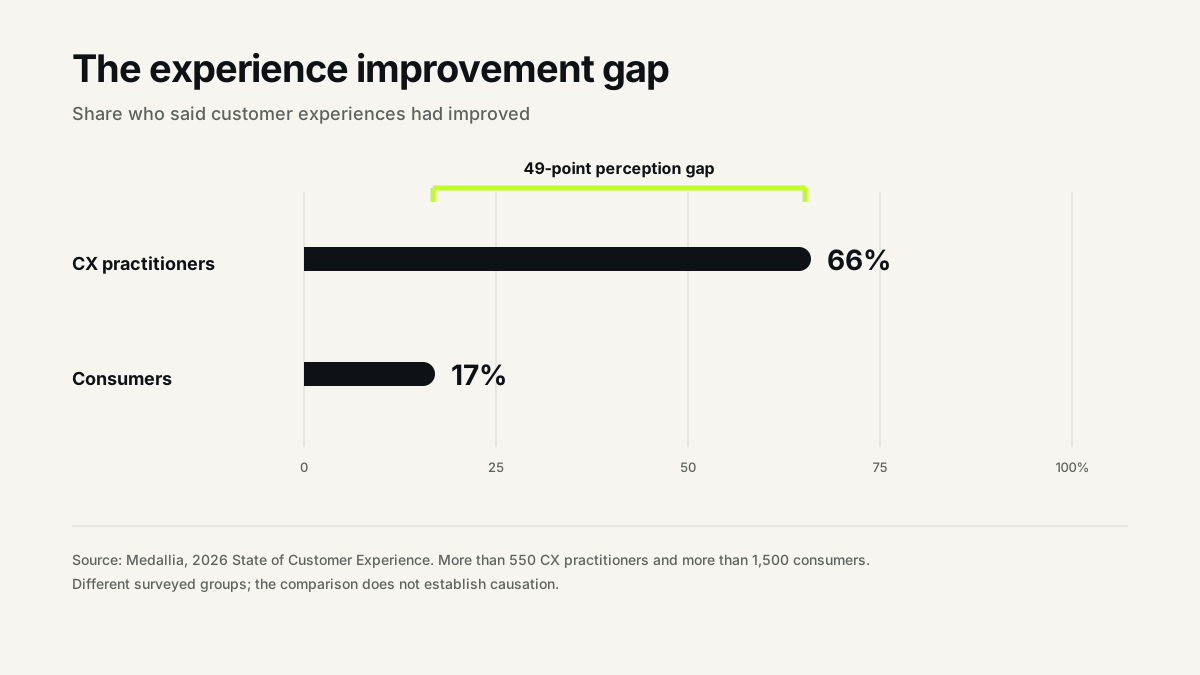
Source: Medallia, 2026 State of Customer Experience. The findings come from different surveyed groups and do not establish a cause for the gap.
Customer engagement, customer experience, satisfaction, and loyalty are related but different
Customer engagement is the interaction and response system. Customer experience is the customer's overall perception of dealing with a company across touchpoints. Satisfaction is an evaluation of whether a particular interaction or experience met expectations. Loyalty is a longer-term tendency to continue, recommend, or prefer a company.
| Concept | Core question | Example measure | Relationship to engagement |
|---|---|---|---|
| Customer engagement | What did the customer and company do? | Useful response, task completion, handoff completion | Describes the interaction and the customer's participation. |
| Customer experience | How did dealing with the company feel overall? | Ease, effectiveness, effort, emotion | Reflects the broader perception created across many interactions. |
| Customer satisfaction | Did this interaction meet expectations? | Post-interaction satisfaction or resolution confirmation | Evaluates a specific moment or episode. |
| Customer loyalty | Will the customer continue, prefer, or recommend? | Renewal, repeat purchase, preference, recommendation | May develop through consistently useful experiences, but is not guaranteed by contact volume. |
The distinctions prevent teams from using a single metric as a stand-in for everything else. A fast support reply may be an engagement action. Whether it solved the problem affects satisfaction. Repeatedly useful experiences can support loyalty, but no message sequence guarantees it. Forrester reported that US customer experience perceptions reached a new low in its 2025 index after four consecutive annual declines, which is context for improving the quality of moments rather than increasing contact frequency. Forrester, "CX Index 2025 Results," June 2025
How do you build a customer engagement strategy?
Build a customer engagement strategy around one priority customer moment. Pair a business objective with a customer outcome, map the signals and friction, design a useful response, assign ownership and handoff rules, then measure the full episode with guardrails. Prove the model in one moment before extending it across the lifecycle.
Pair the business outcome with the customer outcome
Every customer engagement goal needs two sides. The business may need more completed activations, fewer avoidable contacts, or lower cancellation risk. The customer should receive a corresponding gain: faster setup, clearer information, less repeated effort, or a fair resolution.
Write both outcomes in one sentence. For instance: "Help first-time buyers find product compatibility information before checkout, so they can choose confidently and the business can reduce preventable returns." If the customer benefit is vague, the interaction is probably a promotion in search of a reason.
Choose a segment and a lifecycle moment
Start narrower than "improve customer engagement." Choose a meaningful group and a moment with visible stakes: a first login, abandoned onboarding, a delivery exception, an expiring subscription, or a return request. This creates a testable scope and avoids a program that has too many owners.
Prioritize moments using three questions: How many customers encounter this situation? How much effort or uncertainty does it create? Can the business change the experience within 90 days? In online retail, practical moments often deserve more attention than promotional ones. ACSI's 2026 US retail and consumer shipping study highlights checkout ease, product information, delivery quality, and return-process ease among the factors customers rate. ACSI, Retail and Consumer Shipping Study 2026, January 2026
A shared customer record helps the team connect the signal to prior interactions without exposing unnecessary data to every workflow.
Map signals, needs, and friction before selecting a channel
A signal is observable evidence that the customer may need help or may be ready to take the next step. It can be an incomplete setup, a failed payment, a search with no result, a delivery scan, a conversation asking about returns, or repeated visits to the same help article.
For the chosen moment, map the customer need, the signal, the current path, and likely friction. Count more than clicks. Look for repeat contact, transfers, long waits, channel changes, abandoned forms, and requests to restate information. These behaviors do not prove dissatisfaction by themselves, but they identify episodes worth investigating.
Define the value exchange and decision rule
A useful response gives the customer information, control, saved effort, or a resolution. It may be a precise setup checklist, a delivery update with options, an agent callback, or no message at all because the customer has already completed the task.
Use a simple decision rule: engage when a reliable signal indicates a material customer need, the proposed response can improve the customer's next step, and the expected use of their data is clear. Do not engage if the message only serves an internal target, duplicates an action already taken, or depends on sensitive data the customer would not reasonably expect you to use.
Choose the channel for the task and preserve context
Choose a channel based on urgency, complexity, customer preference, and the action required. An in-product prompt can help during setup. Email works for durable instructions. SMS may suit an opted-in, time-sensitive delivery change. A live conversation is often better for nuanced or emotionally charged issues.
Omnichannel engagement does not mean being present everywhere. It means a customer can switch channels without starting over. Define the customer identifier, the case or episode ID, the latest status, actions already attempted, and the next owner that must follow the interaction. A shared conversation workspace can keep that context available to the people responsible for the next step.
Define ownership, automation boundaries, and human handoff
Name one accountable owner for the moment, even when product, support, marketing, and operations contribute. Then document who approves content, who watches performance, who fixes the underlying friction, and who responds when the workflow fails.
Automation should handle bounded, well-understood work. Set escalation triggers before launch: low confidence, a direct request for a person, repeated unsuccessful attempts, sensitive personal or payment data, policy exceptions, suspected harm, or a threshold of elapsed time. The handoff must carry the conversation history, customer details that are necessary for resolution, actions taken, and the reason for escalation. Use explicit team-routing rules so the next owner is predictable rather than chosen ad hoc.
Select the scorecard and guardrails before launch
A response rate is not enough. Choose a small set of metrics that show whether the signal is valid, the workflow works, the customer made progress, and the business gained something durable. Add guardrails for opt-outs, complaints, repeat contacts, privacy incidents, and inequitable outcomes across relevant groups.

The lifecycle operating map connects customer moments to a signal, a useful response, an owner, and evidence of progress.
Customer engagement tactics should match lifecycle moments
The best customer engagement tactics depend on what the customer is trying to do. This is especially important in an online customer engagement strategy, where a team can automate contact faster than it can verify that the contact is useful. The table below is a starting point, not a channel checklist. Each tactic should be tested against the decision rule above.
| Lifecycle moment | Useful engagement | Signal to watch | Progress evidence |
|---|---|---|---|
| Exploring a product or service | Answer eligibility, compatibility, or pricing questions clearly. | Repeated search, comparison-page visits, unanswered chat question | Customer finds an answer or selects a suitable option. |
| Onboarding or first use | Offer a contextual checklist and an easy route to help | Incomplete setup, stalled activation, repeated help searches | Customer completes the core task without repeated assistance. |
| Order, delivery, or service change | Send proactive status and a self-service option when the status changes materially | Delivery exception, backorder, appointment change | Customer confirms the new plan or resolves the exception. |
| Support or recovery | Diagnose the issue, state the next owner, and confirm resolution | Repeat contact, transfer, negative feedback, unresolved case | Customer does not need to reopen or restate the issue. |
| Renewal or ongoing use | Surface a relevant usage review, preference check, or renewal decision | Product-use change, upcoming renewal, account health signal | Customer makes an informed keep, change, or cancel decision. |
A tactic can be appropriate and still fail if the operational experience does not support it. Sending a return reminder cannot fix a hard-to-find label or an unclear policy. In ACSI's study, return-process ease scored lower than checkout ease, a reminder that post-purchase work deserves its own engagement design rather than a marketing afterthought. ACSI, Retail and Consumer Shipping Study 2026
When the signal and decision rule are reliable, event-based automations can deliver the response consistently without turning every lifecycle moment into a broadcast.
A documented no-response ticket closure sequence keeps inactivity rules from silently turning unresolved work into closed cases.
Personalization needs permission, clarity, and restraint
Personalization is useful when it reduces effort or makes an important choice clearer. It becomes intrusive when a company uses data in a way the customer did not expect, repeats details they already supplied, or creates a sense of surveillance.
The trust problem is practical. In Twilio's 2025 survey of 7,640 consumers across 18 countries, 15% said they absolutely trusted brands with their data, and 61% said they did not believe brands used their data in their best interest. Those are self-reported attitudes, not evidence that a particular data practice causes distrust, but they support conservative design. Twilio, State of Customer Engagement Report 2025, June 2025
Use data minimization as an operating rule: collect and expose only information needed for the moment. Explain why a recommendation or reminder appears in plain language. Provide preference controls that are easy to find, respect opt-outs promptly, and set retention practices with legal and security teams where applicable. In a probability-based survey of 5,101 US adults, Pew found that 67% said they understood little or nothing about what companies do with their personal data, while 73% said they had little or no control over it. Pew Research Center, "How Americans View Data Privacy," October 2023
Keep the operational answer in an owned knowledge base so customers, automated systems, and human agents work from the same maintained source.
AI and human support must operate as one conversation
AI customer service works best when it has a bounded job, reliable source material, and a genuine path to a person. It should not be designed solely to keep customers away from people. A high containment rate can hide unresolved work if customers abandon the session or contact another channel.
A human handoff should disclose that the customer is interacting with AI, offer escalation without a maze, and transfer full relevant context to the agent. Microsoft Learn's external engagement guidance recommends disclosure in every external interaction, defined escalation thresholds, full-context transfer, and monitoring for accuracy, groundedness, safety, tone, resolution, abandonment, and handoff patterns. Microsoft Learn, "External engagement pattern," updated July 2026
Document the handoff in plain operational terms: what triggers it, who receives it, what the customer sees, which data transfers, how the receiving person acknowledges ownership, and how the team reviews failures. This is especially important because nearly one in five consumers who had used AI for customer service told Qualtrics they received no benefit. The underlying Q3 2025 research covered more than 20,000 consumers in 14 countries, including the United States. The finding records perceived benefit, not a verified technical failure rate. Qualtrics, "AI-Powered Customer Service Fails at Four Times the Rate of Other Tasks," October 2025

What are the best customer engagement metrics?
The best customer engagement metrics show whether a customer made progress through a complete episode, whether the workflow operated reliably, and whether the result supports the business without damaging trust. Customer engagement optimization should improve this full scorecard, not maximize a single activity measure. No universal metric set fits every moment, so attach each measure to the customer outcome and the decision it will inform.
Use a five-part hierarchy:
- Leading signals: eligible customers reached, help-content search success, setup completion, or response to a material status update. These indicate whether the program reaches the right moment.
- Operating quality: time to first meaningful response, handoff completion, transfer rate, automation confidence, and case routing accuracy. These show whether the system works.
- Customer outcomes: task completion, resolution confirmation, repeat-contact rate within a defined window, effort, and satisfaction for the episode. These are closer to customer progress.
- Business outcomes: retained customers, prevented cancellations, completed activation, repeat purchase, or avoidable-contact reduction. Match the attribution window to the lifecycle moment.
- Guardrails: opt-outs, complaint rate, privacy or security incidents, disclosure compliance, safety review findings, and outcome gaps across relevant groups. These limit harmful optimization.
Define an episode before calculating the scorecard. For a delivery exception, the episode begins at the first status change or contact and ends when the delivery issue is confirmed resolved, not when an email is opened. Include channel switches and handoffs in the record. Compare results with a prior period or a suitable control group where feasible, and annotate operational changes that could explain movement. Do not infer that a message caused retention simply because both moved in the same period.

Framework context: Microsoft Learn external engagement pattern and NIST AI Risk Management Framework.
Use performance reporting to review episode quality and trends without reducing the program to message counts.
A focused 90-day customer engagement plan
A 90-day plan should prove one useful engagement model, not promise a company-wide transformation. Keep the scope to one segment, one lifecycle moment, and one accountable owner.
Days 1 to 30: diagnose and design
Choose the priority moment and write the paired customer and business outcomes. Pull available journey, support, product, and operations data to map the episode. Review a sample of actual conversations or cases for repeat effort and missing context. Agree on the decision rule, data use, preference requirements, baseline metrics, and escalation triggers.
Days 31 to 60: build and test the smallest useful workflow
Create the response content, routing logic, context fields, and human handoff confirmation. Test edge cases with the teams that receive escalations, including a customer request for a person, missing information, a low-confidence AI answer, and an opt-out. Validate that the relevant customer history appears for the next owner. If AI is part of the workflow, configure it as bounded AI assistance with maintained source material and explicit escalation rules.
Days 61 to 90: launch, review, and decide
Launch to a limited eligible group where possible. Review operating quality and guardrails weekly, then review customer and business outcomes at the cadence appropriate to the moment. Keep a decision log: continue, change the trigger, alter the response, address root friction, or stop. Expand only when the program helps customers and does not create a trust or workload problem.
Common customer engagement mistakes
Measuring activity instead of customer progress
Open rates, sessions, messages sent, and bot containment can be useful diagnostics. They are weak success measures on their own. Pair them with completion, resolution, repeat effort, and a guardrail that catches unwanted contact.
Starting with channels instead of a moment
"We need an SMS strategy" skips the customer need and can create unnecessary outreach. Define the lifecycle moment and valuable response first, then choose the least intrusive effective channel.
Treating handoff as a failure
A well-timed escalation can be the best result. The failure is making a customer repeat information, wait without ownership, or discover too late that an automated system cannot solve the case.
Calling every tailored message personalization
Using a name or purchase history does not make a message helpful. Personalization must be relevant to the task, expected by the customer, and supported by a clear benefit.
Running a campaign without fixing the underlying friction
More reminders cannot repair broken product information, unreliable delivery updates, or a confusing return process. Assign a root-cause owner and route recurring issues back to the team that can change the experience.
Practical FAQ
What is the difference between a customer engagement strategy and a customer engagement plan?
A customer engagement strategy defines the decisions that govern useful interactions: which signals matter, the customer value to create, channels, ownership, handoffs, measurement, and trust boundaries. A customer engagement plan is the execution schedule for a specific initiative. A plan can sit inside a strategy, but a calendar by itself does not tell a team whether an interaction should happen.
How often should a company contact customers?
Contact customers when there is a material reason that helps them make progress and aligns with their preferences. There is no universal safe frequency. Monitor opt-outs, complaints, response quality, repeat contact, and outcomes by segment. A lower-volume program that resolves a real need is usually more valuable than a high-volume sequence that customers ignore.
What should a customer engagement strategy template include?
A customer engagement strategy template should define the segment, lifecycle moment, paired customer and business outcomes, observable signals, helpful response, channel, and timing. It should also cover consent and preferences, ownership, AI and human handoff rules, metrics, guardrails, and review cadence. The copy-ready template above turns those fields into an operating document rather than a presentation slide.
How should AI hand off a customer to a human agent?
AI should hand off when it lacks confidence, the customer asks for a person, the issue is sensitive or complex, a policy exception is needed, or prior automated attempts have not helped. It should tell the customer what will happen next and transfer the full relevant context: the conversation, verified account details, actions already taken, and the escalation reason. The person who receives the case should visibly take ownership rather than ask the customer to start again.
Is customer engagement the same as customer experience?
No. Customer engagement is the system of interactions and responses between a company and customer. Customer experience is the customer's broader perception of those interactions and the surrounding product, service, and operations. Engagement can improve an experience when it reduces effort or adds value, but frequent contact can also worsen an experience when it is irrelevant or disruptive.
Build for useful contact, then expand carefully
A durable customer engagement strategy earns attention by helping customers at a real moment of need. Start with one episode, make the response and ownership explicit, and use the scorecard to learn whether the customer made progress. If your team needs a way to connect helpful conversations with routing, knowledge, and measurement, explore the customer engagement features that support the relevant workflow.